
May 20, 2026
How do Tiny Homes Deal with Sewage and Waste Water?
Tiny homes solve a lot of problems that conventional housing can’t. They’re affordable to build, easy to move, and light on infrastructure. One of the questions that comes up early in the planning process — and one worth understanding clearly before you commit to a site — is sewage. It’s not glamorous, but it’s also not complicated. Here’s how it works.
Tiny Homes vs. RVs
Most people assume that because tiny homes are regulated as RVs, they handle waste the same way. But actually, they don’t.
A conventional RV has holding tanks — one for gray water (sinks, shower) and one for black water (toilet). You empty them when they fill up, whether that’s at a dump station or by connecting a hose at an RV park. Even if you’re parked in the same spot for weeks, you still use the tank-and-dump cycle.
Most tiny homes are plumbed differently. They’re designed for a permanent, direct connection to a sewer system — no holding tank, but continuous flow, exactly like a conventional house. This makes the day-to-day experience much more normal, but it also means the connection setup is a bit more involved than plugging in an RV hose.
Connecting to City Sewer
If you’re parked in a location with access to municipal sewer, this is the cleanest and most straightforward option. Wastewater flows out of your tiny home and directly into the city system, just like any other residence on the block.
The connection point is called an RV sewer stub — a capped sewer access point at ground level that connects to your home’s drain line. Many RV parks and tiny home communities have these built into each site. If you’re setting up on private property, a licensed plumber will need to install one, which requires a permit. The hookup itself — connecting your tiny home to an existing stub — typically doesn’t require a separate permit.
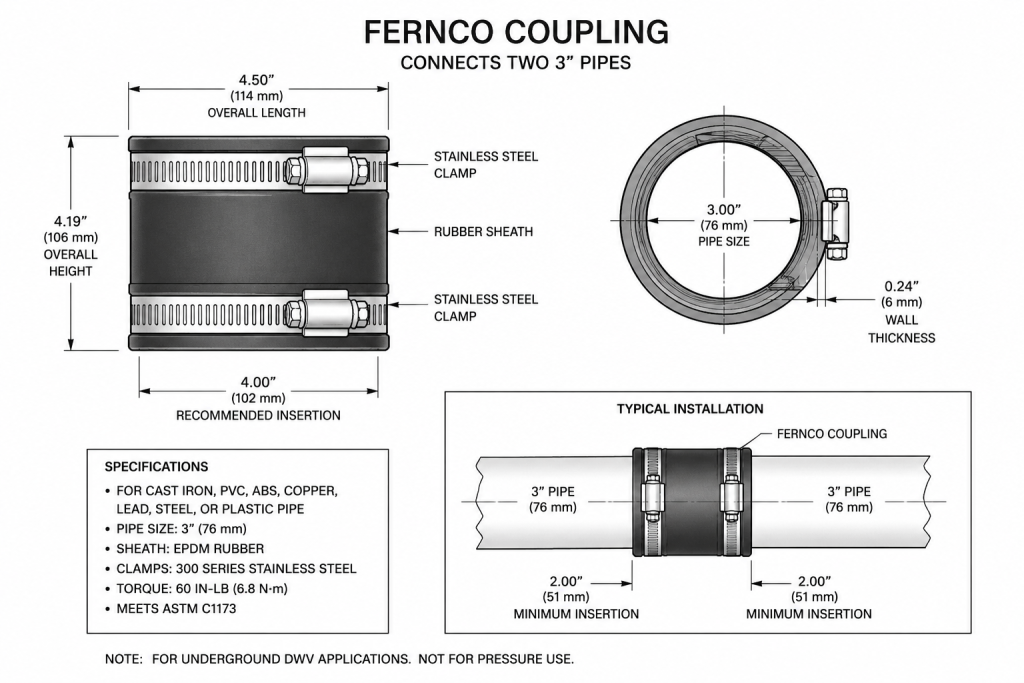
The connection between your tiny home’s drain outlet and the sewer stub is made with a Fernco coupling — a rubber fitting with hose clamps that creates a watertight connection between two pipes without threading or gluing. They’re flexible, durable, and widely used for exactly this application. It’s a simple, reliable connection once the stub is in place.
Rural: Connecting to Septic
Outside city limits, most properties handle wastewater through a private septic system. Tying a tiny home into an existing septic system is often possible, but there’s one thing worth checking first: capacity.
Septic systems are designed and permitted for a specific volume of daily wastewater, typically calculated based on the number of bedrooms in the primary residence. Adding a tiny home to the same system adds load. Whether that’s a problem depends on how heavily both the main house and the tiny home are used, and how much headroom the existing system has.
In some cases a septic system can absorb the additional load without modification. In others, the system will need to be evaluated by a licensed septic professional and potentially upgraded — a process that involves the county and can be expensive. It’s worth having that conversation early, before you’ve committed to a site.
The Tank Option
If connecting to city sewer or an existing septic isn’t feasible, a holding tank is a practical alternative. A tank — buried or above-ground — collects wastewater and gets pumped out on a regular schedule by a septic service company. Frequency depends on usage, but for a single occupant a pump-out every few weeks is typical.
It’s not the most elegant solution, but it works well for rural or semi-rural siting where running a new septic system isn’t warranted. It’s also flexible — you’re not making a permanent infrastructure commitment to a specific site.
Mount Baker Tiny Homes builds custom tiny homes on wheels and van conversions in Bellingham, Washington. Questions about how your build would connect to utilities at a specific site? Get in touch.